SlowDen › Blog › The 1-3-5-7 rule for studying
What is the 1-3-5-7 rule for studying? How to use it for exams, and what the research actually says
the 1-3-5-7 rule for studying is a spaced-repetition schedule: after you learn something, you review it 1 day, 3 days, 5 days and 7 days later. Each review is short and done from memory (quiz yourself, don't reread). The exact numbers are a rule of thumb, but the idea behind them, spreading reviews out instead of cramming, is one of the best-supported study techniques there is.
This article was written with the assistance of an AI writing program. The research claim is from the Association for Psychological Science summary of Dunlosky et al. (2013); the schedule follows the University of Arizona's spaced-repetition guide and common study-guide descriptions, read 26 November 2026; SeaSweep facts were read from its source code the same day.
What does the 1-3-5-7 rule mean?
You learn a topic on day 0. Then:
| Review | When | What to do |
|---|---|---|
| 1 | Day 1 | Close your notes, write down everything you remember, then check |
| 2 | Day 3 | Answer 5 to 10 practice questions on it |
| 3 | Day 5 | Explain it out loud or teach it to someone |
| 4 | Day 7 | One more quick self-test; if it's solid, move to weekly reviews |
Some guides count the learning day itself as "day 1", so you may also see it written as same day, then days 3, 5 and 7. Either works; what matters is that the gaps get longer.
Is the 1-3-5-7 rule backed by research?
The principle is. The Dunlosky et al. review rated distributed practice (spreading study over time) and practice testing as high-utility techniques, and rereading as low. The specific days 1, 3, 5 and 7 are not from a single study; they are a convenient pattern. Related schedules like 1-3-7 and 2-3-5-7 follow the same logic. The University of Arizona's guide to spaced repetition explains the general method.
How do I use the 1-3-5-7 rule for exams?
- Start early enough. For a full cycle on a topic you need 7 days before the exam, so new topics should stop about a week out.
- Keep a review list. Write each topic with the four dates next to it.
- Make reviews short. 10 to 20 minutes per topic is enough; the point is retrieving, not relearning.
- Test, don't reread. Every review should start with your notes closed.
- Stack reviews into one session a day. On a busy day you might have three topics due; do them back to back in one session.
What does a 1-3-5-7 study week look like?
If you learn Topic A on Monday and Topic B on Tuesday: A is reviewed Tuesday, Thursday, Saturday and the next Monday; B on Wednesday, Friday, Sunday and the next Tuesday. Most days end up with one new topic plus one or two short reviews.
How do I stop getting distracted during short review sessions?
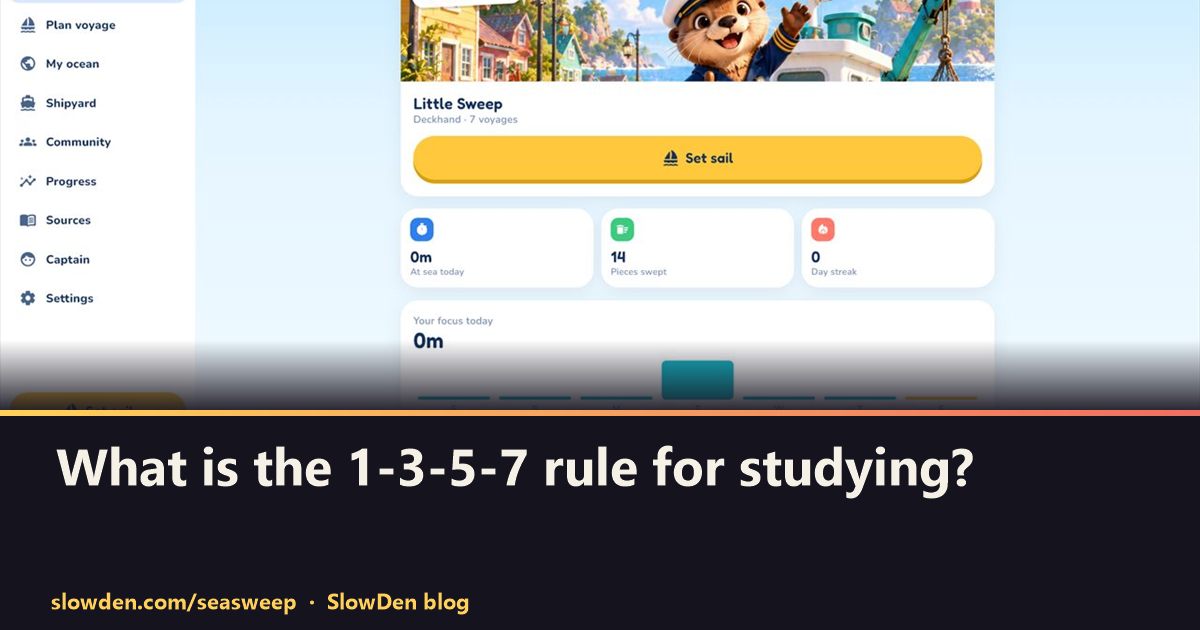
Short sessions only work if you actually finish them. On a Windows PC, SeaSweep turns each session into a sea voyage: you pick a route whose length is the session (any route can be shortened to 5 minutes, the longest is 3 hours), and while the ship sails it closes the apps and tabs you docked, such as Discord, Steam, YouTube or Instagram. There is no pause button, which suits a 15-minute review well. It is free on the Microsoft Store. More: how to block games on Windows while studying.
Prefer the command line? In Windows Terminal: winget install 9N3F281GJT5T -s msstore
Get it: SeaSweep on the Microsoft Store (Store ID 9N3F281GJT5T). More: slowden.com/seasweep. For a break with a natural end after a review session, a free browser puzzle like Sudoku by 3S Games on slowden.com, from the same founder. SeaSweep is made by a 5 Gyres Ambassador. @5gyres #5GyresAmbassador
Common questions
What is the 1-3-5-7 rule for studying?
Review new material 1, 3, 5 and 7 days after you first learn it, testing yourself each time instead of rereading.
Does the 1-3-5-7 rule work?
The idea behind it, spacing out reviews and testing yourself, is rated high utility by a major research review. The exact days are a rule of thumb rather than a tested formula.
What is the difference between the 1-3-5-7 and the 2-3-5-7 method?
Only the first gap. 2-3-5-7 starts with a review on day 2 instead of day 1. Both spread four reviews across a week.
How long should each review be?
Usually 10 to 20 minutes per topic. Keep it short and active: questions, flashcards or explaining it out loud.
Is SeaSweep free?
Yes. It's free on the Microsoft Store, for Windows.
Browse the games
All 2961 free browser games on SlowDen — no download, no sign-up.